Zero Liquid Discharge Concept – Brine Minimization Technology
Client:
Fryer's Cove ProjectCategory:
Zero Liquid Discharge ConceptTags:
wind turbine, energy, innovation
Zero Liquid Discharge Concept - Brine Minimization Technology
DDFS has Overcome the Brine Minimization Challenges in Desalination.
Advanced Reject Recovery of Concentrate with Disposal (ARROCWD) is a high-recovery, advanced membrane system that couples softening process with RO to increase water recovery.
System Energy Requirement’s : 0.90 kWh/m3 The system is designed to cater for autonomous energy supply to a super capacitors back-up for 24h21min and will charge in full sun, within 4h40min for a 1 million cycle.
ZLD concepts, brine minimization technologies, and challenges in desalination
High recovery systems aimed at brine minimization have been defined in municipal desalination as those systems achieving recoveries higher than 92% . ZLD is defined as a high recovery system allowing that no effluent leaves the ground-level plant boundary. In a ZLD approach, all the brine is either recovered by a combination of technologies to produce desalinated water or dry salts. Technologies commonly recommended in ZLD processing systems include: RO, vacuum evaporators, crystallizers, evaporation ponds and spray dryers. Salinity and composition of the brine to be processed in the ZLD system has a substantial influence on capital and operating costs. Sequential and selective removal/ recovery of salts from concentrated brine should follow from low to high solubility levels. Although technically feasible, high recovery and ZLD systems are currently not economically viable in municipal desalination. As previously stated, membrane desalination is considered to be the predominant technology to be used in municipal desalination and ZLD systems. Operating costs are reduced by applying a system including consecutive RO stages for brine minimization.
By implementing ‘seawater membranes’ in the second stage, Rw increases and additional permeate output can be achieved . The osmotic pressure depends on the concentration of dissolved salts in solution . Due to the lower salinity of the brackish feed water, ‘RO line 1’ operates at a lower pressure. The brine generated in ‘RO line 1’ is then fed into ‘RO line 2’, where the salinity becomes higher. Overall, tandem RO processes for maximum water recovery and RO brine minimization are considered to be promising alternatives in brackish water desalination. Particular process conditions need to be analysed carefully on a site-by-site basis .
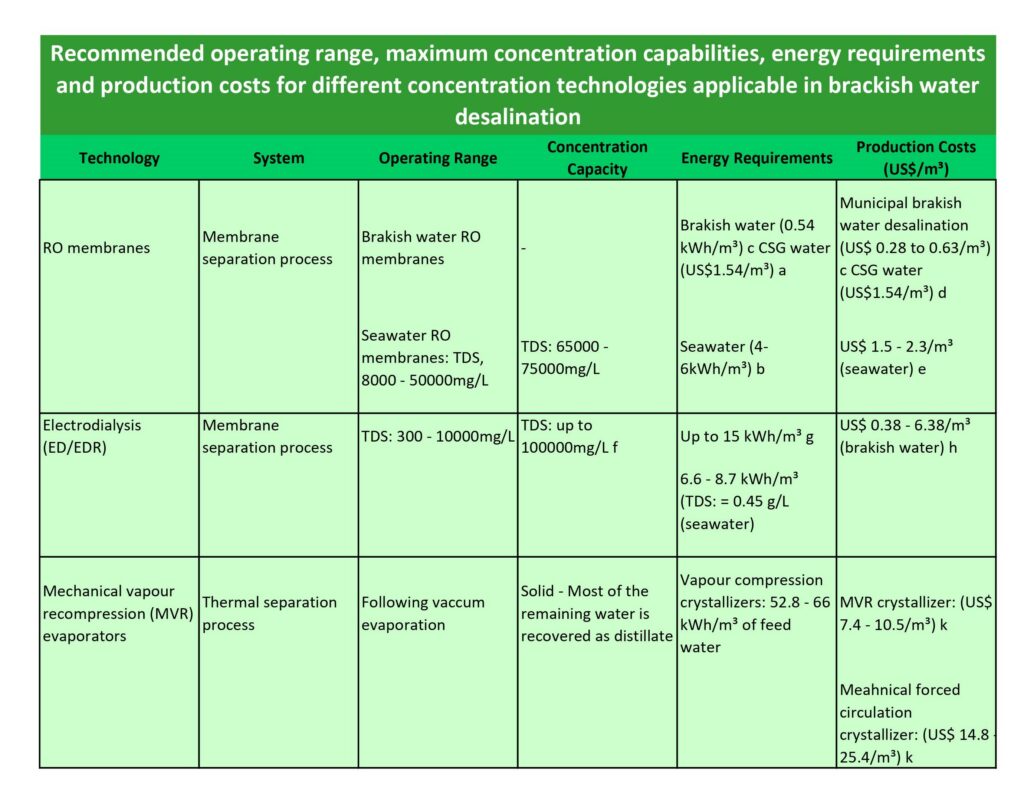
Electrodialysis (ED) or electrodialysis reversal (EDR), forward osmosis (FO) and membrane distillation (MD) are also membrane separation processes. ED is another desalination technology that employs electrical potential difference to move ions through ion-exchange membranes. As shown in Table 6, ED is considered as an alternative to RO but it is often only recommended for treating brackish water with TDS level below 10,000 mg/L . For higher salinities, RO is more competitive since ED cost is proportional to the amount of salts carried through the membrane [59]. Further research is required to avoid scaling in ED units and to improve selectivity and permeability of membranes . FO is another technology for brine concentration with low energy consumption. In contrast to RO, the osmotic pressure is the driving force for mass transport .
The main drawbacks of FO technology are the risk of salt precipitation on the membrane, the need to develop more robust membranes and a suitable draw solute to improve the separation process. Table summarizes the main features of significant concentration technologies applicable in municipal desalination depending on feed water salinity.
As shown in Table , RO is by far the most cost-effective solution in terms of energy consumption, capital and operating costs. MD, FO and ED technologies have been tested on a pilot plant scale for RO brine minimization in inland desalination, although it is difficult to assess their feasibility on an industrial scale. Martinetti et al. tested/compared vacuum-enhanced direct contact membrane distillation (VEDCMD) and FO for RO brine minimization in two different streams with TDS levels averaging 7,500 and 15,000 mg/L. Rw levels in both technologies were limited by salt precipitation.